Key Takeaways
- Agricultural drone work can enhance the management of pasture, hay, and alfalfa by addressing challenges like musk thistle invasion.
- The Revolution Drones I-19 offers efficient herbicide applications without disturbing the soil, making it ideal for wet conditions.
- Drone applications allow for precise targeting of problem areas, reducing chemical use while maximizing effectiveness.
- They can assist in weed control, alfalfa stand mapping, and even seeding without the downsides of traditional methods.
- Using drones for pasture management can also qualify for tax credits under R&D activities, providing additional financial benefits.
Some of the most beautiful agricultural land in NE Kansas may not involve row crops. Instead, it may be the pastures, hay meadows, and alfalfa fields that provide forage for livestock operations. Agricultural drone work has traditionally focused on row crops, but I think that these forage fields can also benefit from ag drones. Flying these pasture, hay, and alfalfa acres allows these areas to maximize their input as a major part of NE Kansas economy.
The Problem for Every Pasture, Hay, and Alfalfa Field
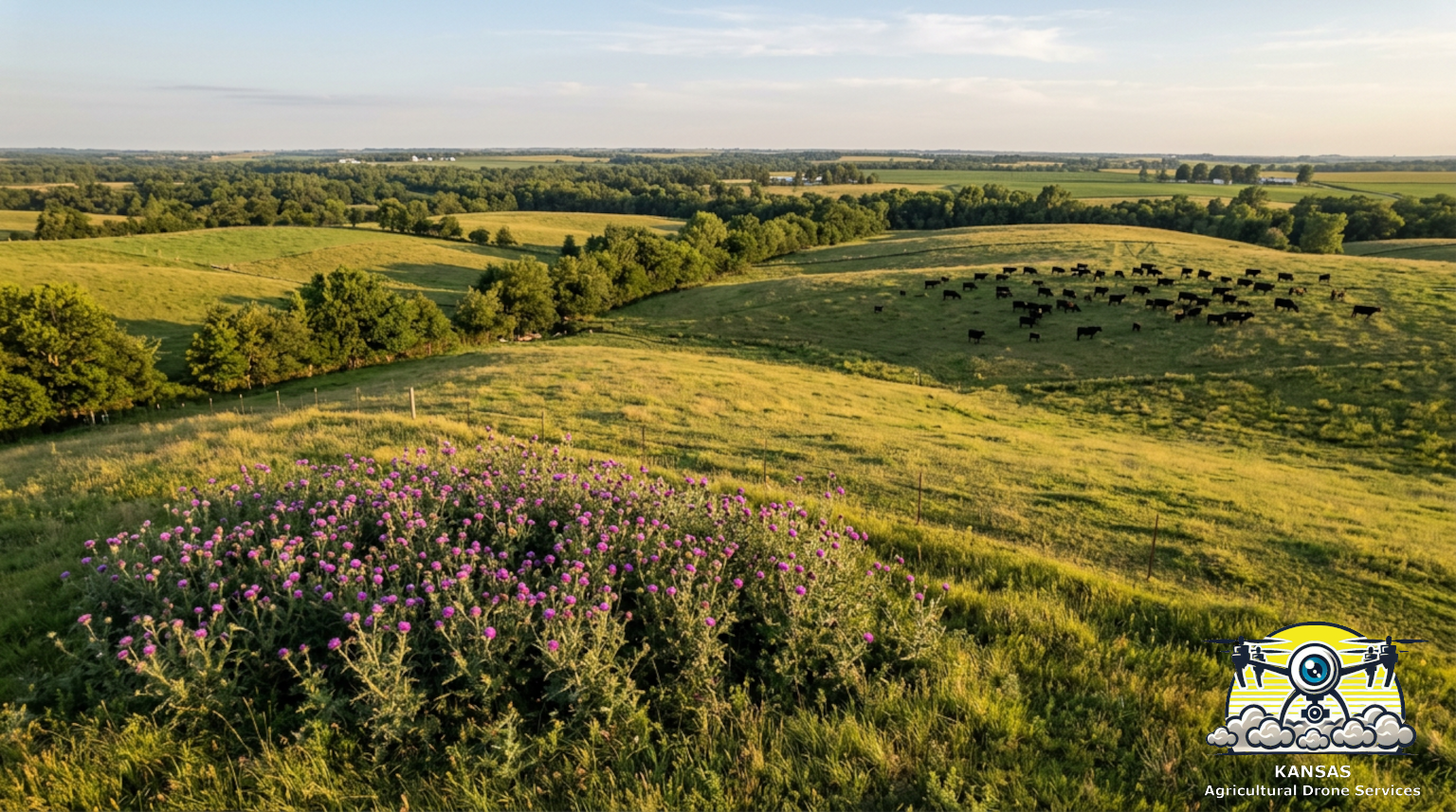
Drive on many of the gravel roads in Brown or Doniphan County (or neighboring counties) in late May and you’ll spot the issue: The purple powder-puff flowers of musk thistle blooming along fence lines, in the low corners of pastures, and creeping into hay ground. They are pretty, in an irritating sort of way.
Musk thistle (Carduus nutans) is a Category C noxious weed in Kansas. State law requires that landowners control it. It’s not optional. And the biology of this plant makes the timing of control critical. A single plant can produce more than 10,000 seeds, and those seeds can remain viable in the soil for a decade or more. Miss the spray window by a few weeks, and you’re not just dealing with this year’s problem. You are also supporting the problem in future years.
The challenge for pasture operators has always been access and timing. Musk thistle is most susceptible to herbicide treatment during its rosette stage. This is either in the fall before it overwinters, or in the early spring before it bolts. Both windows are often wet. Ground rigs will have real problems getting into the fields during these windows. The patches that need spraying most are rarely the patches that are easiest to reach.
This is exactly the problem drone spray pasture applications solve.

How can the Revolution Drones I-19 Help?
I currently fly the Revolution Drones Independence-19 (aka, “The I-19”) and it’s worth understanding what that aircraft is actually capable of before writing off drone application as a niche tool useful only for large row crop operations.
The I-19 can handle both liquid herbicide application and dry granular application on the same platform. It runs RTK GPS guidance for high pass-to-pass accuracy, and its obstacle avoidance system lets it work confidently in and around the tree lines, terraces, and creek draws that define pasture, hay and even alfalfa ground in NE Kansas. It can dispense up to 20 gallons per flight (when overfilled) and up to 175lbs of granular material! Under good conditions with efficient support, the I-19 can cover up to 750 acres a day.
That’s not a toy. That’s a purpose-built agricultural aircraft.
More importantly, the I-19 operates without the ground pressure of any wheeled or tracked equipment. It doesn’t compact wet soil in draws. It doesn’t tear up the fescue stand you’ve spent three years building. It doesn’t get stuck in the creek bottom where your worst thistle patches tend to concentrate. And because it can switch between spray, spread, and seed operations the same platform, one day can accomplish what would otherwise require multiple equipment passes and multiple days of field access.
Here’s how I think a typical pasture herbicide works best:
- We plan ahead and walk your fence lines in early spring and flag the concerning areas using the RTK tools. Or, even better, I fly a scouting pass first to map what’s actually out there and define obstacles. Drone cameras can clearly locate musk thistle rosettes against dormant grass from 50 feet up, even before the plants are easy to see from the ground.
- We schedule the application to occur at the most impactful time.
- We use an approved herbicide like dicamba, picloram, and aminopyralid (Milestone). Label rates for aerial herbicide are typically 3 to 5 gallons of carrier per acre for aerial herbicide application. We spot-spray directly onto the rosettes, right when they’re most susceptible. Cattle return to the pasture following the labeled restrictions.
No soil compaction. No widened gates. No ATV tracks through your fescue stand. Probably also less cussing.
Hay Meadows and Alfalfa: Similar Issues
Musk thistle gets the attention because it carries a legal obligation, but the hay ground and alfalfa fields of northeast Kansas carry their own challenges that I may be able to address:
- Hay field applications for broadleaf weed control. These fields have the same access problem as pastureland. A hay meadow that’s too wet for a ground rig in early spring may allow dock, ironweed, and thistles to gain a foothold. A drone flight targeting broadleaf pressure before first cutting, while the stand is still short and conditions on the ground remain marginal, can significantly reduce weed competition without waiting for field conditions that may never fully arrive in a wet spring.
- Alfalfa stand mapping. Drone scouting can show where a stand is thinning before it becomes a replant decision. Thin areas in alfalfa often don’t announce themselves from the cab until they’re well established. From 100 feet up, the contrast in canopy density is visible and mappable. Knowing where those areas are, and whether they’re growing or stable, may change how you manage inputs and when you make a replant call.
- Drone scouting for Alfalfa weevil. Alfalfa weevil pressure in northeast Kansas typically peaks in late April through May, when the stands are hardest to walk and your decisions about first cutting are being made. A multispectral pass over a large alfalfa field can identify stressed areas and uneven stand density that walking the field simply can’t match. Couple that with your own binocular assessment, or live drone flight, from the top of my trailer and you can make decent assessment about cutting and treatment without guesswork.
- Cover crop seeding into standing hay. Many farmers are interested in cover crop seeding from a drone. Producers who want to overseed legumes into established hay stands, to improve forage quality and nitrogen fixation without the disruption of tillage or drilling, can accomplish that with the seeding capability of a Revolution Drones machine. I can spread the seed at the right point in the growing season regardless of how wet the field is. No compaction, no stand damage, no equipment that requires removing the crop first.

CRP Ground and Conservation Plans
Conservation Reserve Program ground in Brown County, Doniphan, Nemaha, and Atchison counties are sometimes troubled by woody encroachment — eastern red cedar, hedge, and multiflora rose working in from the draws year by year. If these are NOT part of your conservation plan, or if you run afoul of the 5% canopy rule, you may want to consider removing these plants. The I-19 can treat the invaders with drone-applied herbicide without disturbing the grass stand or triggering the compliance concerns that come with walking heavy equipment into enrolled acreage.

Using Drones can reduce your tax!
A reminder that section 41 of the TAX code allows some of the cost of R&D activities to turn into a TAX Credit. Testing new techniques is encouraged by the Government, and use of drones or hiring a drone service is an allowable activity.
The Operator Difference
Many aerial herbicide application services available in northeast Kansas are optimized for flat, open-field row crop work measured in thousands of acres. 20 acres of pasture or a 40-acre hay meadow with a thistle problem or an alfalfa field that needs weevil scouting before a cutting decision, isn’t their business model.
But it is Mine. I live to help farmers. Let me help you.
Stay in touch!
Yes, with the proper licensing. Drone pesticide application in Kansas requires a commercial applicator certification and a separate UAS Application approved by the Kansas Secretary of Agriculture. Kansas Agricultural Drone Services, llc operates in full compliance with Kansas Department of Agriculture requirements.
It depends on the product. All herbicides carry specific grazing and haying restrictions on the label — this applies to both ground and aerial application. Before any treatment, we review the product and its restriction periods with you so you can plan accordingly. Common products like Milestone (aminopyralid) have relatively short grazing restrictions for beef cattle, but some carry longer haying restrictions. We walk through that before scheduling any flight.
Modern agricultural spray drones carry between 4 and 10+ gallons per load, depending on the model, and can refill quickly in the field. For large acreage with scattered infestations, the efficiency comes from targeting — spraying only where the problem exists rather than broadcast-treating the entire field. This targeted approach typically reduces chemical cost significantly.
I can fly a low-altitude scouting pass using a camera-equipped drone before the spray flight. Musk thistle rosettes are visually distinctive from the air — their dark green color and radial leaf pattern stand out against dormant or early-growth grass. I can provide you with a map of identified patches and a recommended spray plan before we commit to application.
Drone application is effective for any weed that can be treated with a product registered for aerial application. In Kansas pastures, this commonly includes musk thistle, bull thistle, multiflora rose, and various broadleaves. Talk to me about your specific weed pressure and I’ll tell you honestly whether a drone is the right tool for your situation.
The I-19 carries a 19-gallon liquid spray tank for herbicide or fungicide applications, and a separate 26-gallon dry tank rated for 175 pounds of granular material for spreading or seeding. Under good conditions with efficient field logistics, operators plan for up to 600 acres within an application window. For pasture and hay work with scattered infestations, efficiency comes from targeting only problem areas, not broadcasting across the entire field.
Whether you own the ground or lease it for grazing, I am glad to work with you. For leased ground, it’s good practice to loop in the landowner before treatment, and I can help facilitate that conversation if needed. Grazing lease operators often find drone services particularly useful because the I-19 requires only a place to bring in my trailer to set up near the field.
It depends on the situation. For large, flat, easily accessible fields with uniform pressure, a ground rig may be more economical per acre. For patchy infestations in wet or hard-to-access hay ground, pasture draws, or alfalfa fields where timing is everything, drone application is cost-competitive — and when you factor in avoided soil compaction, reduced chemical use from targeted application, and the value of hitting the right spray window, the math can shift further in favor of the drone.
Yes. A low-altitude camera pass over an alfalfa field during the right growth stage, typically when the crop is 8 to 12 inches tall and weevil pressure is building, identifies tip feeding damage and stand stress patterns across the whole field. I will deliver georeferenced maps showing where pressure is concentrated so you can make cutting and treatment decisions with confidence. This is especially useful on larger alfalfa acreage where foot-scouting is difficult.