Drones today can be tiny toys you fly in a park, or a smooth camera platform that takes breathtaking photos, or even a large and heavy machine that sprays crops across hundreds of acres. That wide range of machines all share a single story: people learned how to control things remotely from the ground, then improved the parts and control systems until those flying things could do real work. This is the history of drones.
My personal journey started with a GMP Cricket fixed-pitch RC Heli powered by a glow-plug engine. “Fixed pitch” means the rotor blades were fixed at a certain angle, and lift was generated by changing the speed of the rotor, which created the need for more compensating tail pitch. I learned a lot of physics during my first few flights (er, uhm, crashes). I progressed through other models that included enhancements such as collective pitch, gyro stabilizers, and fancy radios, to models with electric motors, and then on to the Revolution Drones I-19 I now fly. From full manual control to tail-assist systems, to fancy electronic motors, and now to the fully programmed and stabilized beast that weighs more than 300lbs and sprays hundreds of acres a day. Wow. What a ride.
This article (attempts) tells this story more dispassionately from the earliest radio‑controlled helicopters and model airplanes through the DIY drone boom, the rise of camera drones, and the large agricultural drones used on farms today. The history is long and varied, and selected the events or models that came into appearance in my own life. I will attempt o explain the basic physics of flight, how helicopters and multirotors steer, and why batteries, sensors, and rules matter. I hope that the tone is simple and clear so that any reader can follow along, but the article is detailed enough to be useful for anyone who wants a solid, authoritative history.
Early ideas and the first unmanned machines
The idea of controlling a vehicle without a person inside goes back more than a century. Inventors experimented with remote control and automatic guidance long before small electric motors and light batteries existed. One of the earliest public demonstrations of remote control was a radio‑controlled boat shown by an inventor at the end of the 1800s. That demonstration proved that wireless signals could steer a machine from a distance.

During World War I and the years that followed, engineers built pilotless aircraft for scouting and target practice. Control was about maintaining stability – flying in a straight line for a certain amount of time and then dive down onto whatever was below. These early machines were heavy, hard to control, and mostly experimental, but they proved the idea: a flying machine could be guided without a pilot on board.
In the 1930s and 1940s, companies began to mass‑produce small target drones for military training. These were simple, rugged aircraft that helped anti‑aircraft crews practice. Making many of these machines taught manufacturers how to build unmanned aircraft reliably and at scale. That manufacturing experience later helped civilian makers when hobby electronics and small motors became available.

RC helicopters and model airplanes: the hobby roots
For many decades, the most common unmanned flying machines were radio‑controlled (RC) model airplanes and helicopters. Clubs of hobbyists met on weekends to fly, trade parts, and teach new pilots. Early RC models used simple radios and small engines. Over time, radios improved so pilots could control more than one function at once. Servos, the small motors that move control surfaces, became more precise. These improvements let model pilots fly more smoothly and try more advanced maneuvers.
RC helicopters were especially interesting. A helicopter is harder to fly than a fixed‑wing plane because it must balance lift and control in every direction. This personally fascinated me. Many of the full-size helicopters were first flown as models to test control theory. This was because there was still so much being learned about how to control the rotors, and the disc they described as they rotated. Even into the 1960s! In the early days, the “hobby” of helicopter flight and the development of real helicopters were hardly separated. Despite entering the hobby in the late 1970s, maybe 30 years following development of real helicopters, there was still rapid-fire development of helicopter theory and mechanics, and I immersed myself in books about the theory and design of these crazy machines. Several of the books featured Dieter Schlütеr, the leading innovator in flying helicopter models.

Models became more sophisticated as time moved forward, and we hobby pilots learned about collective and cyclic control of the rotor disc, various methods of controlling rotors, how to balance the blades, how to track the rotors, the mechanical design of the rotor head, and how to tune a machine so it hovered steadily. In fact, hovering steadily was a major part of flight and many modelers progressed little beyond competent hovering. Companies that made RC helis refined the mechanical parts, rotor heads, swashplates, and linkages, so hobbyists could fly safely and learn real aeronautical skills.

Those hobby years mattered because they created a community of people who understood flight, electronics, and repair. There were fly-in conventions, competitions, and of course the regular Saturday flying sessions at the local school yard. When small sensors and cheap microcontrollers arrived, that community was ready to build more advanced machines. Off we go!
The DIY revolution: open software and cheap parts
In the early 2000s, three things came together and changed everything: small, cheap sensors, lightweight batteries, open‑source flight software and gathering places on the internet supported the hobby. Tiny gyroscopes and accelerometers (often combined into an IMU, or inertial measurement unit) let a small computer know which way a drone was tilting. Ingenious use of infrared sensors provided a horizon line to stabilize the model (lots of infrared from the sky, little from the ground). Lithium‑polymer batteries gave a lot of power for their weight. Open projects shared code that could stabilize a flying machine automatically. Much of these ideas were freely exchanged, much like the early days of the computer revolution.

Hobbyists, mere mortals like you and I, began building multirotor drones, the quadcopters, hexacopters, and more, using off‑the‑shelf motors, propellers, and flight controllers. Communities online shared designs, tuning tips, and software updates. That sharing made it possible for a teenager in a garage to build a stable flying camera platform on a six-rotor craft that would have been impossible a decade earlier.
At the same time, some companies took the DIY ideas and made polished products. They combined reliable hardware with easy software so people who did not want to build could still fly. That step turned drones from a hobby for tinkerers into a tool for photographers, surveyors, and farmers.

The physics of flight: lift, thrust, and balance
To understand how helicopters and drones fly, it helps to know a few basic physics ideas.

- Lift is the upward force that keeps a machine in the air. For rotors and propellers, lift is created when blades push air downward. The faster the blades move or the steeper their angle, the more air they push and the more lift they make.
- Thrust is the force that moves a machine forward, backward, or sideways. On a helicopter, thrust comes from tilting the rotor disk or changing blade pitch at certain points in the rotation. On a multirotor, thrust is created by changing the speed of individual motors.
- Weight is the downward force from gravity. To hover, lift must equal weight. To climb, lift must be greater than weight.
- Torque and yaw: When a rotor spins, it creates a twisting force on the body of the aircraft. Helicopters use a tail rotor or other systems to counteract that torque. Multirotors use pairs of rotors spinning in opposite directions so the torques cancel out.
These ideas are simple, but making a machine that balances lift, thrust, and torque in real time requires careful design and fast control systems.
Helicopter mechanics: swashplate, collective, and cyclic

A helicopter—whether a full‑size machine or a small RC heli—controls flight with a clever mechanical device called the swashplate. The swashplate sits below the spinning rotor and has two main parts: a stationary ring and a rotating ring. The stationary part connects to the pilot’s controls; the rotating part turns with the rotor and changes the pitch of each blade as it spins.
Two main control inputs come through the swashplate:
- Collective changes the pitch of every blade the same amount at the same time. When the pilot raises the collective, every blade bites into the air more and the helicopter climbs. Lower the collective and the helicopter descends.
- Cyclic tilts the swashplate so that the pitch of each blade changes depending on where it is in the rotation. That variation makes the rotor disk tilt in a direction, which moves the helicopter forward, backward, or sideways.
This swashplate is part of a flying model. Raising the swashplate increase the pitch of both blades simultaneously (elevator), thus providing more vertical lift. Tilting the swashplate causes the blade pitch to change as it rotates, creating lift in the direction of tilt. Tilt the swashplate forward and left and the craft will have more lift in that direction and fly forward and to the left.

The swashplate is a brilliant mechanical solution that translates the simple movement of transmitter sticks into complex, timed changes in blade pitch. RC helicopter pilots learn to use collective and cyclic together to hover, move, and land smoothly. The same principles apply to large helicopters used for spraying crops. There are many variations on the swashplate in both model and full-size helicopters but ultimately, the take-away is that they control the pitch of each rotor blade in a coordinated and harmonious way.
How multirotors steer themselves: sensors and control loops
Multirotor drones—quadcopters, hexacopters, and octocopters—do not use a swashplate. Instead, they steer by changing the speed of each motor. It is much more of a brute-force method, and thus less elegant, but it does provide the control we need with a much less complex set up. That simplicity makes multirotors mechanically easier to build, but it requires fast electronics to keep them stable.
Key parts of a multirotor control system:
- IMU (inertial measurement unit): This sensor package includes gyroscopes and accelerometers that measure rotation and acceleration. The flight controller reads the IMU hundreds or thousands of times per second.
- PID controllers: These are control loops that compare the drone’s current attitude (tilt and rotation) to the desired attitude and compute motor speed adjustments. PID stands for Proportional, Integral, Derivative—three terms that help the controller correct errors smoothly.
- GPS and magnetometer: For position hold and navigation, GPS tells the drone where it is on the Earth, and a magnetometer helps it know which way is north. More advanced systems use RTK GPS for centimeter‑level accuracy.
- Barometer and optical flow: A barometer measures altitude by air pressure. Optical flow sensors and cameras can help a drone hold position when GPS is weak.
When a pilot or an autopilot asks the drone to move forward, the flight controller increases the speed of the rear motors and decreases the speed of the front motors. The difference in thrust tilts the drone forward and it moves. The IMU senses the tilt and the PID controller adjusts motor speeds to keep the motion smooth. This loop happens many times per second, so the drone appears to steer itself.
Drone photography and imaging: new eyes in the sky
One of the first big civilian uses for drones was aerial photography. Before drones, taking photos from the air required a plane or helicopter. Drones made aerial images cheap and easy. A small camera on a gimbal can take smooth, stable video and high‑resolution photos. Photographers use drones for real estate, weddings, news, and nature shots.

Beyond pictures for people, drones carry special cameras that help scientists and farmers. Multispectral cameras capture light in colors humans cannot see. By comparing different bands of light, software can show where plants are stressed, where irrigation is needed, or where pests may be active. Mapping software stitches many overlapping photos into a single, detailed map called an orthomosaic. These maps let farmers measure field area, count plants, and spot problems early.
Agricultural drones: spraying, mapping, and precision farming

Agricultural drones are a special class of machines built to help farmers. They do two main jobs: imaging and spraying.
- Imaging drones carry multispectral or thermal cameras to map crop health. A drone can fly a field in a short time and produce a map that shows where plants are growing well and where they are not. Farmers use those maps to apply water, fertilizer, or pesticides only where needed.
- Spraying drones carry tanks and nozzles to apply liquid chemicals. These drones fly precise GPS paths and spray only the areas that need treatment. Because they fly low and slow, they can apply chemicals more accurately than a plane and faster than a person with a backpack sprayer.
Some agricultural drones are small and battery‑powered; others are large and use gasoline engines or hybrid power to carry heavier loads. Manufacturers designed purpose‑built unmanned helicopters decades ago for crop spraying, and modern multirotor sprayers combine that heritage with GPS guidance and flow‑controlled nozzles.
The result is precision agriculture: using data and machines to apply inputs only where they help, saving money and reducing environmental impact.
Batteries, sizes, and tradeoffs
A drone’s design is a balance of weight, power, and time. Batteries are heavy, and heavier batteries let a drone fly longer or carry more weight, but they also make the drone heavier to lift. Most small camera drones fly 15–30 minutes on a single battery. Agricultural drones that carry spray tanks may use larger batteries or different power systems to fly longer and carry heavier payloads. They also require care to get the full use out of these expensive items.
Drones come in many sizes:
- Toy drones: tiny, light, and cheap. Good for learning indoors.
- Hobby camera drones: mid‑size, with good cameras and gimbals for smooth video.
- Professional mapping drones: built for long flights and accurate sensors.
- Heavy‑lift agricultural drones: large frames, strong motors, and big tanks for spraying.
- Industrial drones: custom machines for lifting, inspection, or long‑range missions.
Choosing the right drone depends on the job. A hobby drone is great for photos, but a farm that needs spraying will choose a heavy‑lift agricultural drone with the right safety features and approvals.
Military influence, rules, and safety
Military research pushed many drone technologies forward. Long‑range radios, reliable autopilots, and advanced sensors were developed for defense projects and later adapted for civilian use. That transfer of technology helped civilian drones become more capable and reliable.
As drones became common, governments created rules to keep people safe. In the United States, rules require many drones to be registered, set altitude limits, and restrict flying near airports and crowds. Commercial drone pilots often need training and certification. For heavy agricultural drones that spray chemicals, pilots and operators must follow extra safety rules and sometimes get special approvals.
Safety also depends on training and community standards. Hobby clubs teach safe flying, and professional operators follow checklists and maintenance schedules. As drones become more autonomous, engineers are building better sense‑and‑avoid systems so drones can detect obstacles and other aircraft and respond safely.
The future: smarter, longer, and more useful
Drones will keep getting better. Batteries will improve, sensors will become cheaper and more accurate, and artificial intelligence will let drones make smarter decisions in the air. For agriculture, that means faster mapping, more precise spraying, and better tools to help farmers grow more food with fewer resources.
At the same time, rules and public expectations will shape how drones are used. People want the benefits of drones—better photos, safer inspections, more efficient farms—without new risks to privacy or safety. That balance will guide us all in how we move forward.
Closing Thoughts
The path from early RC helicopters to today’s agricultural drones is a story of steady invention, community learning, and clever engineering. Hobby pilots learned to fly with simple radios and mechanical swashplates. Makers and open‑source projects added sensors and software that let drones stabilize themselves. Manufacturers turned those ideas into reliable products for photographers, surveyors, and farmers. Military research pushed the technology forward, and regulators set rules to keep the skies safe.
Understanding the physics—how lift is made, how a swashplate controls a rotor, and how multirotors use motor speed and sensors to steer—helps explain why drones work and why they are useful. Batteries and payload limits explain why drones come in many sizes. Imaging and spraying show how drones can help people do important jobs more efficiently.
Drones are not just toys or tools; they are a new way to see and work in the world. From backyard RC helis to large agricultural drones, the story is still unfolding. Engineers, hobbyists, farmers, and regulators will keep shaping that story for years to come.
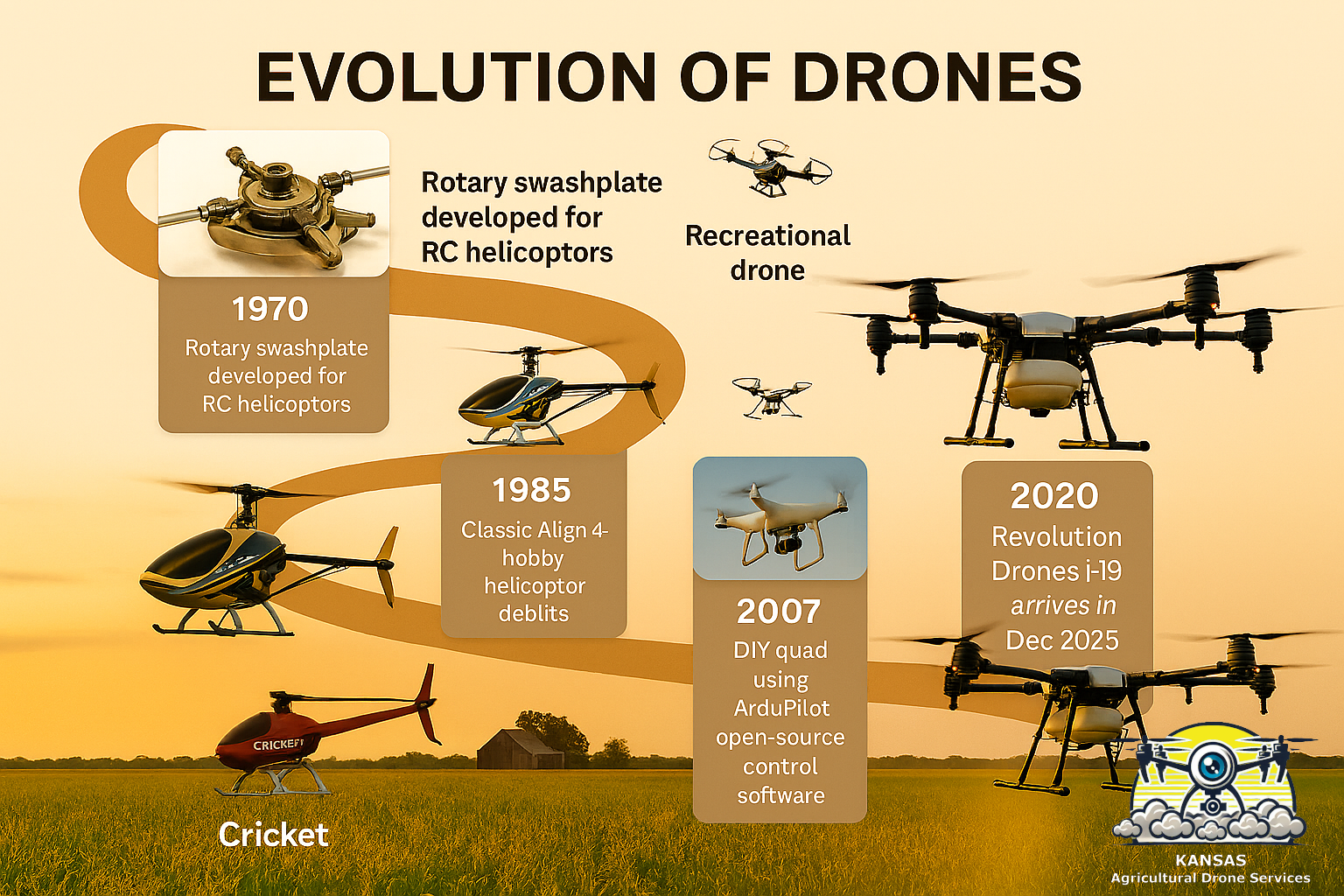
This timeline traces civilian drones from early demonstrations of remote control through today’s agricultural drones. It has been an exciting century and a quarter, and we stand poised for even more excitement in the coming years.
- 1898 — Remote control demo: Nikola Tesla shows a radio‑controlled boat, proving wireless control.
- 1918 — Kettering Bug: Charles F. Kettering builds the Kettering Aerial Torpedo, an early unmanned aircraft.
- 1939–1940s — Mass target drones: Reginald Denny / Radioplane OQ‑2 becomes the first mass‑produced U.S. drone for training.
- 1970s–1990s — RC heli hobby growth: Japanese makers (e.g., Hirobo, Kyosho, Align) refine RC helicopter kits and rotorheads.
- 1990s — Agricultural helicopters: Yamaha R‑MAX developed for precise crop spraying in Japan.
- 2007–2014 — DIY/autopilot era: ArduPilot / 3DR / DIYDrones open‑source movement enables hobby drones and early commercial mapping.
- 2006–2015 — Consumer boom: DJI (founded 2006) popularizes camera drones (Phantom) and later the Agras agricultural series.
- 2012–2016 — Regulation: FMRA 2012 and FAA Part 107 (2016) create commercial rules, registration, and pilot certification.