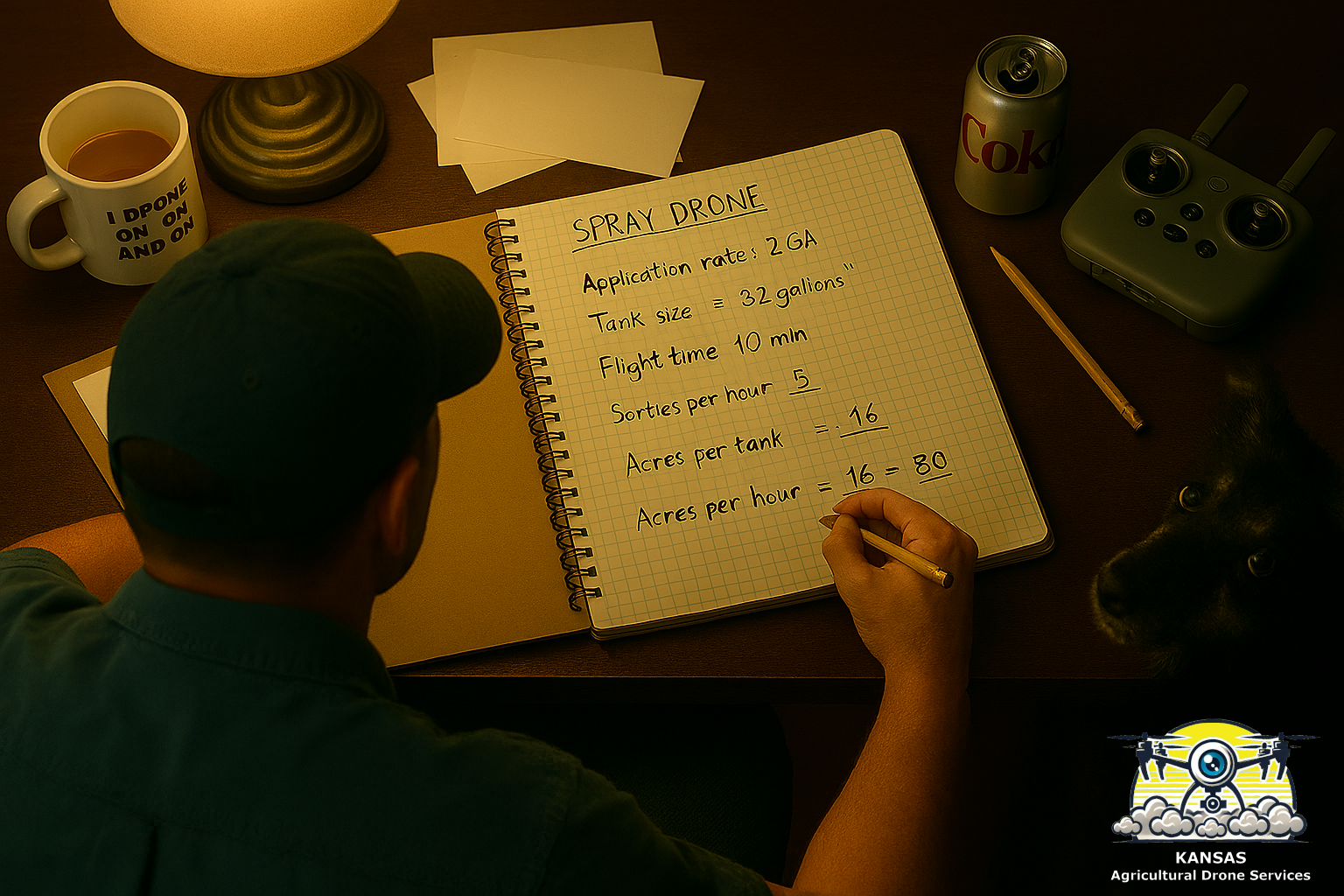
Key Takeaways
- To spray 320 acres using a 32-gallon drone at 2 GPA, you need to complete 20 sorties in about 4 hours.
- The drone can run 5 sorties per hour, with each sortie taking approximately 12 minutes, including refills and battery swaps.
- Preparation involves ensuring the drone and equipment are operational and staging the chemicals safely before starting.
- Proper crew roles enhance efficiency: a pilot for flight, a refill technician for quick refills, and a battery tech for monitoring battery health.
- Consider operational risks such as refill delays and weather changes; plan for contingencies to maintain workflow.
Assume you’ve just been asked to spray a large field. Great news, right! If you’re planning to spray 320 acres, what are the steps to confirm you can spray the field in a timely way?
Below is my own way of thinking through this issue using a 32-gallon spray drone. Read it, steal it, make it your own.
Assignment:
Apply fungicide at 2GPA on 320 acres. Using my 32-gallon drone. It needs to be done tomorrow. Go!
TLDR:
For a 32‑gallon spray drone applying 2 GPA, providing 5 sorties per hour during a 10‑hour workday, my single aircraft can cover 320 acres in about 4 hours of active spraying. That requires 20 sorties (tank fills), a tight battery and refill workflow, and a small ground crew to sustain the 5‑sortie cadence.
Spray Job Assumptions
- Application rate: 2 gallons per acre (GPA).
- Tank size: 32 gallons.
- Sorties per hour: 5 (one sortie ≈ 12 minutes including flight, return, landing, battery/tank swap).
- Workday: 10 hours of productive spraying.
- Acres per tank = Tank capacity / Gallons per acre
- Acres per hour = Acres per hour * length of day
- Turnaround includes landing, battery swap, quick inspection, and refill.
Core Calculations
- Acres per tank:
32GAL / 2GPA = 16 acres per tank - Acres per hour:
16 acres * 5 sorties = 80 Acres per hour - Acres per 10‑hour day:
80 acres per hour * 10 hours = 800 acres - Sorties to cover 320 acres:
320 acres / 16 acres per tank = 20 sorties - Time to complete 320 acres at 5 sorties/hr:
20 sorties / 5 sorties per hour = 4 hours (theoretically)
A Practical Schedule for Spray Drone Application
It looks like you can handle the job! In this case, 320 acres can be sprayed within four hours. So if you’re a planner, you may want to think through your day. Here is how I would approach this:
Total sorties: 20
Estimated active spraying time: 4 hours
Typical cycle (one sortie): ~12 minutes — flight + return + landing + swap/refill
Example timeline (single drone, one crew):
- Pre‑flight (30–45 min): system checks, battery staging, chemical mixing and staging.
- Sorties 1–5 (Hour 0–1): 5 sorties → ~80 acres covered. Ground tech refills between each sortie.
- Sorties 6–10 (Hour 1–2): Next 80 acres. Quick maintenance check at end of hour 2.
- Sorties 11–15 (Hour 2–3): Next 80 acres. Check trailer equipment, top up chemical supply.
- Sorties 16–20 (Hour 3–4): final 80 acres; finish spraying by end of hour 4.
- Post‑flight (15–30 min): clean nozzles, secure chemicals, stow equipment, log data. Bill your client before you leave the field.
The remaining 6 hours of the workday cover delays, crew breaks, weather windows, or additional passes if needed. Or you have time to move on to another field.
Battery, charger, and crew recommendations
- Battery pool: 4–6 batteries recommended. Here is why: with a ~12‑minute cycle, one battery is in use while others cool/charge; 4–6 packs provide a buffer for charger throughput and unexpected delays. Importantly, the extra batteries allow extended cool-down time, which is good care for an expensive resource!
- Charger count: 1, if it is a fast charger. 2 may give you more flexibility, especially if they are not fast chargers or if you have more batteries. Make good decisions to care for your batteries!
- Ground crew: 1–2 trained technicians: one dedicated to refilling and chemical handling, one to manage batteries, chargers, and safety checks. For faster turnaround or multiple drones, add staff. You may reduce one position if you are using hot loads and avoid mixing chemicals.
- Refill equipment: Dispensing nozzle or quick‑connect hoses, calibrated flow meter, and spill containment. Aim for <2 minutes per refill to sustain cadence. Check your pump capabilities!
- Spare parts: extra nozzles, filters, and a backup set of rotors and arms.
Operational risks and mitigations
- Payload weight effect: The full 32 gal load increases aircraft weight and may reduce flight time per battery; verify your actual flight minutes under full load and adjust sorties/hr if needed. It is best to do this at the start of the season.
- Refill bottleneck: Slow pumping or awkward plumbing will reduce sorties/hr. 5 sorties per hour assumes you are moving quickly. It doesn’t leave time to troubleshoot; Be sure to invest in quick‑connect fittings and a high‑flow pump.
- Battery charging: Insufficient chargers or slow charge times force more batteries; plan charger capacity to match consumption.
- Weather windows: wind or temperature changes can impact flights; the 4‑hour active spray time fits well into typical calm periods but keep flexibility in your day.
- Regulatory compliance: follow label rates, buffer zones, and drift mitigation practices; document each pass. Find a useful flight logging system!
If you want to scale or add redundancy
- Two‑drone option: two identical 32‑gal drones working in parallel double throughput to ~160 acres/hr (theoretical), finishing 320 acres in ~2 hours, but require doubling battery pools, chargers, and at least one additional ground tech.
- Mixed fleet option: pair a 32‑gal drone with a 20‑gal spray drone to balance quick nimble passes and longer single‑tank runs; this can improve uptime if one aircraft needs maintenance.
Quick checklist before you run this job
Before you accept this job, you should have already confirmed the following:
- Flight minutes under full 32‑gal load.
- Measure real refill time with your pump and fittings.
- Verify charger throughput and battery charge time.
- Stage chemicals and PPE for easy, and safe, use.
- Run a short pilot (1–2 hours) to validate sorties/hr and adjust battery/crew counts.
- Equipment is in good working order.
- Chemicals are in stock or easily obtainable on the way to the field.
You can Execute the Mission!
You should now have confidence you can safely and efficiently fly this field and apply the fungicide the next day. What does that look like? When should your girlfriend drop off sandwiches? Open the panel, below!
Scenario: Spray 320 acres using a single 32‑gallon drone; 2 GPA; 5 sorties per hour (~12‑minute cycle); 3 batteries in rotation; refill 1.25 minutes; battery charge 10 minutes; 20 sorties required; active spray time ≈ 4 hours.
Preflight from trailer 07:00–07:30
- 07:00–07:02 — Crew arrival, don PPE, open trailer doors.
- 07:02–07:05 — Start generator; close breakers; confirm circuits to trailer power panel and chargers.
- 07:05–07:08 — Unpack drone, inspect airframe, props, nozzles, plumbing filters.
- 07:08–07:12 — If not hot-tanking, then stage chemicals in trailer tanks, verify mix and label rates, set spill containment at trailer edge.
- 07:12–07:15 — Check batteries A/B/C state of charge; mount Battery A on drone.
- 07:15–07:18 — Power on controller and drone; connect telemetry and confirm link to controller. Note and mark obstacles. Confirm RTK (yes, use your RTK)
- 07:18–07:22 — Upload flight plan, confirm GPS and telemetry, set field transition path from trailer to first swath.
- 07:22–07:25 — Final safety brief; assign roles (pilot, refill tech, battery tech).
- 07:25–07:30 — Arm systems, quick systems check, taxi test from trailer deck if applicable; ready for first sortie.
Active spraying detailed minute‑by‑minute 07:30–11:36
Cycle template about 12 minutes — takeoff from trailer and transit to field transition path (~1.0–1.5 minutes); spray passes (~9–10 minutes); return to trailer transition path and land on trailer deck or designated landing pad; battery swap and refill (~1.5–2.0 minutes, includes 1.25 minute fill). Batteries rotate A → B → C → A.
Sortie 1
- 07:30 — Takeoff from trailer with Battery A; position on field transition path.
- 07:31–07:41 — Spray passes; pilot monitors flow, GPS track, and wind.
- 07:41–07:42 — Return to trailer transition path; land on deck/landing pad.
- 07:42–07:43.15 — Refill tank (1.25 min); place Battery A on charger.
- 07:43.15–07:44 — Quick systems check; prepare Battery B for launch.
Sortie 2
- 07:44 — Takeoff with Battery B; position to next block.
- 07:45–07:55 — Spray passes.
- 07:55–07:56 — Return and land at trailer.
- 07:56–07:57.15 — Refill (1.25 min); Battery B to charger.
- 07:57.15–07:58 — Prep Battery C for launch.
Sortie 3
- 07:58 — Takeoff with Battery C; position to field.
- 07:59–08:09 — Spray passes.
- 08:09–08:10 — Return and land.
- 08:10–08:11.25 — Refill (1.25 min); Battery C to charger.
- 08:11.25–08:12 — Prep Battery A (now charged) for launch.
Sorties 4–20
Repeat the 12‑minute cadence with battery rotation and 1.25‑minute refills at the trailer. Key start times:
- Sortie 4 08:12–08:24
- Sortie 5 08:24–08:36
- Sortie 6 08:36–08:48
- Sortie 7 08:48–09:00
- Sortie 8 09:00–09:12
- Sortie 9 09:12–09:24
- Sortie 10 09:24–09:36
- Sortie 11 09:36–09:48
- Sortie 12 09:48–10:00
- Sortie 13 10:00–10:12
- Sortie 14 10:12–10:24
- Sortie 15 10:24–10:36
- Sortie 16 10:36–10:48
- Sortie 17 10:48–11:00
- Sortie 18 11:00–11:12
- Sortie 19 11:12–11:24
- Sortie 20 final 11:24–11:36 — final passes; return and land; mission spray complete. Relax.
Note — final secure and cleanup on trailer typically takes twenty minutes after the last landing.
Post‑flight and remainder of day 11:36–17:00
- 11:36–11:45 — Secure drone on trailer, download and save flight logs and GPS tracks.
- 11:45–12:05 — Clean nozzles, strainers, and flush lines per label instructions; secure chemical tanks.
- 12:05–12:35 — Lunch and crew break; batteries continue charging.
- 12:35–13:05 — Inspect batteries, log cycles and temperatures; rotate any weak packs out.
- 13:05–13:45 — Equipment maintenance: inspect props, filters, pumps; replace parts as needed.
- 13:45–14:30 — Complete application records, compliance paperwork, and upload maps.
- 14:30–15:30 — Pack hoses, stow pump and fittings, secure chemicals in trailer.
- 15:30–16:00 — Debrief with crew; note lessons and schedule next maintenance.
- 16:00–16:30 — Shut down generator, open breakers for safe storage, secure trailer.
- 16:30–17:00 — Final site check, depart site.
Crew roles trailer checklist and contingencies
- Pilot — flight execution, telemetry monitoring, emergency response. Confirm controller and drone power on each sortie.
- Refill tech — operate trailer pump, quick‑connects, flow meter, and spill containment; target ≤1.25 minutes per refill.
- Battery tech — swap batteries, monitor chargers, log battery health and temperatures.
- Trailer checklist before first sortie — generator started; breakers closed; chargers powered; controller and drone powered; chemicals staged; spill kit accessible; landing pad or deck clear.
- Contingencies
- Battery underperforms mid‑sortie — land at trailer transition path immediately, swap to charged battery; expect 5–10 minute delay.
- Refill exceeds 1.25 minutes — cadence drops; use buffer time later in day.
- Weather shift — pause spraying and shelter electronics. Resume when safe.