Key Takeaways
- Soil compaction quietly impacts yields, fuel efficiency, and overall soil health, often worsened by modern heavy equipment.
- Spray drones help reduce soil compaction by applying crop protection without touching the soil, preventing new compaction.
- Using biological products like Bio S.I. Agriculture or SB 25 can rebuild soil structure and improve infiltration and root growth.
- A practical strategy combines using drones for applications in wet fields and applying biologicals for rebuilding damaged areas.
- Monitoring improvements with drone imagery helps track soil health and productivity over time.
Soil compaction is one of those problems every farmer knows is out there, but it’s easy to underestimate just how much it steals from your bottom line. You don’t see compaction the way you see weeds or disease. You don’t get a text alert when your subsoil hits 300 PSI. But year after year, compaction quietly chips away at yield, fuel efficiency, soil health, and water infiltration.
And here’s the kicker: modern farms are running heavier equipment than ever. Bigger sprayers, bigger planters, bigger grain carts. Great for efficiency—terrible for soil structure.
But there’s good news. New tools like spray drones, along with biological soil products like Bio S.I. Agriculture, are giving farmers real ways to reduce compaction and even reverse some of the damage already done.
I’ll dig into what’s happening under the surface and how drones help keep fields lighter, healthier, and more productive.
🚧 What Exactly Is Field Compaction?
Soil compaction happens when soil particles get pressed together so tightly that the pore space—the little pockets that hold air and water—collapses. When that structure collapses, roots struggle, water can’t move, and biology suffocates.

The main causes of farm compaction:
- Heavy equipment (sprayers, tractors, grain carts)
- Repeated passes in the same wheel tracks
- Working ground when it’s too wet
- Livestock traffic
- Natural settling in low-organic-matter soils
The symptoms farmers see:
- Stunted or uneven crop growth
- Ponding or slow infiltration
- Sidewall smearing during planting
- Roots growing sideways instead of down
- Lower yields in “problem zones” year after year
The hidden costs:
- Reduced nitrogen efficiency
- More runoff and erosion
- Higher fuel use for tillage
- Delayed field access after rain
- Lower drought resilience
Compaction isn’t just a nuisance—it’s a structural soil problem that affects every part of the crop’s life cycle.
🧱 Why Modern Equipment Makes Compaction Worse
Today’s sprayers can weigh 30,000–40,000 pounds loaded. Planters with fertilizer tanks can push 20,000+ pounds. Grain carts? 40,000–60,000 pounds is common.
Even with flotation tires or tracks, the sheer weight creates deep compaction layers—often 6–18 inches down—where roots need to grow.
And here’s the part most farmers don’t love to hear: Most compaction happens on the first pass. Once a wheel track is formed, every additional pass just makes it worse.
That’s why reducing passes—not just reducing weight—is the real key.

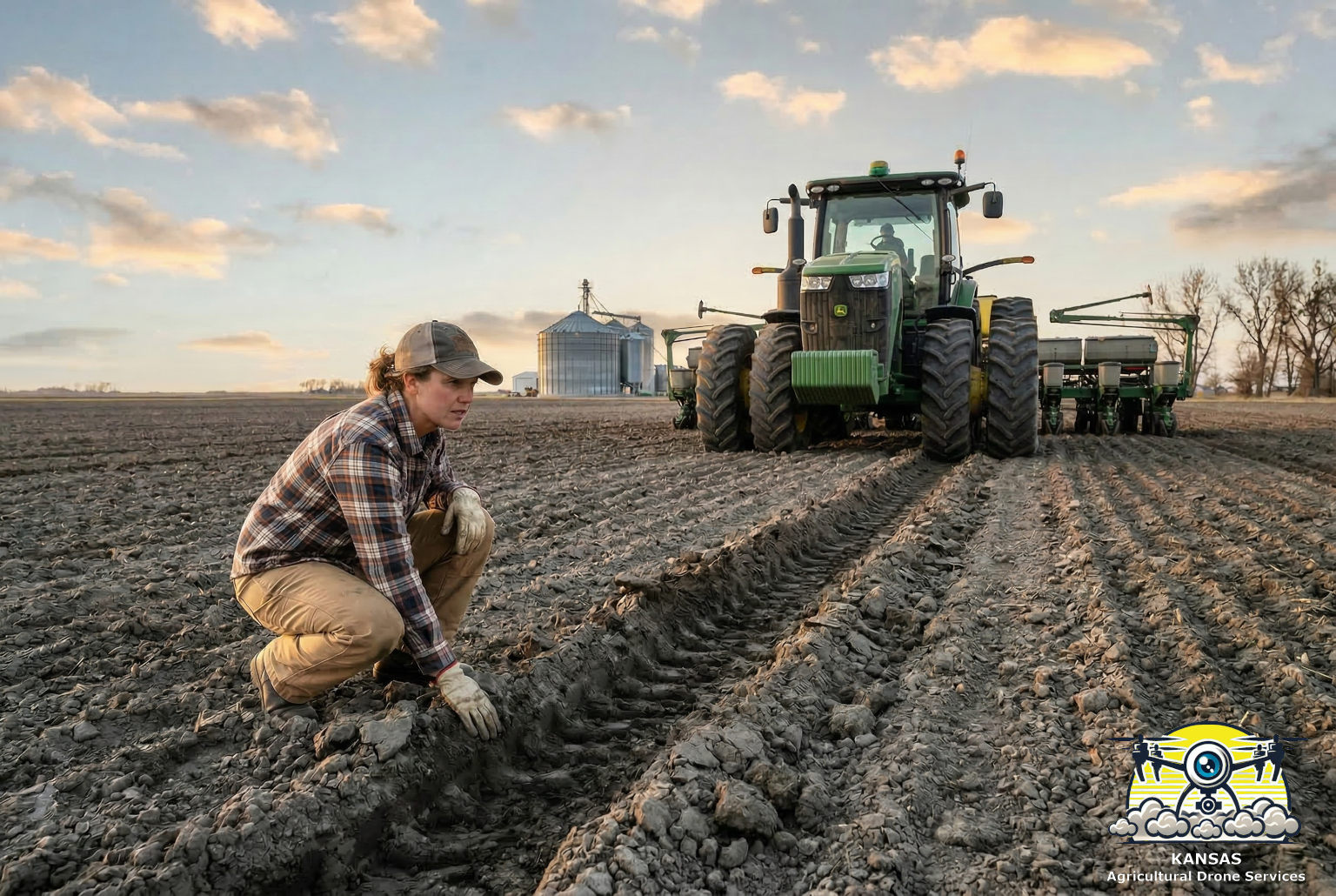
This is a field I am monitoring. Three generations have farmed it and used similar practices. The equipment has evolved over time, to try and reduce PSI with treads, wide tires, etc. Much of the soil compaction is worn in so deeply nothing grows there. Worse, there are several additional tracks that are just now starting to emerge as problem areas.
🛩️ How Spray Drones Help Reduce Field Compaction
Spray drones are more than just cool new gadgets. They are also a fundamentally different way to apply crop protection, biologicals, and foliar nutrients without ever touching the soil.
Here’s how drones help farmers avoid compaction:
1️⃣ Zero Ground Pressure — Literally No Compaction
A drone never touches the field. No ruts. No wheel tracks. No PSI on the soil surface.
This is especially valuable:
- After heavy rains
- In low spots
- On headlands already beaten down by equipment
- In no‑till systems where soil structure is everything
When a drone flies the application, the soil stays intact.
2️⃣ Timely Applications When Ground Rigs Can’t Run
Every farmer knows the frustration of watching disease spread or weeds bolt while the sprayer sits because the field is too wet.
Drones don’t care. They can fly:
- The day after a rain
- In muddy fields
- Over standing water
- In areas where a ground rig would get stuck
As long as we can get our drone tender near the field, we will fly!
Timely application = better control and higher yield potential.
3️⃣ No Headland Beating
Headlands are the first place compaction shows up. Ground rigs turn, brake, accelerate, and overlap there.
Drones?
They take off from the field edge and never touch the crop zone.
Your headlands stay healthier, and yield maps show it.
4️⃣ Precision Spot Spraying Reduces Passes
With drone mapping and NDVI imagery, you can treat only the acres that need it.
Instead of running a 120‑foot boom across the whole field, a drone can:
- Hit only the drowned-out patches
- Treat only the disease pockets
- Spray only the weed escapes
Fewer ground passes = less compaction.
5️⃣ Perfect for Small Fields, Terraces, and Odd Shapes
Ground rigs struggle in:
- Terraced fields
- Narrow waterways
- Small patches
- Timber edges
- Pivot corners
Drones thrive in these environments, eliminating the need for extra turns and extra wheel traffic.
🌱 Biological inoculants May Help
Avoiding compaction is ideal—but most farms already have compacted layers from years of heavy equipment.
That’s where biological soil products come in.
Bio S.I. Agriculture offers microbial products designed to rebuild soil structure by increasing biological activity, improving aggregation, and helping organic matter break down more effectively.
Here’s how they help with compaction:
🧬 1. Microbes Rebuild Soil Structure
Healthy soil biology creates glues and polysaccharides that bind soil particles into stable aggregates. Aggregates = pore space = better infiltration and root growth.
Bio S.I. products introduce and stimulate beneficial microbes that help rebuild this structure.
💧 2. Improved Water Infiltration
Compacted soils shed water. Biologically active soils absorb it.
Bio S.I. Agriculture products help:
- Increase infiltration
- Reduce ponding
- Improve water-holding capacity
- Reduce runoff
This is especially important in no‑till systems where natural structure is the backbone of the system.
🌾 3. Stronger Root Systems Break Through Compaction
Microbial activity helps roots grow deeper and more aggressively.
Roots are nature’s subsoiler.
The more roots you have, the more channels you create for:
- Air
- Water
- Nutrients
- Microbial movement
Bio S.I. products support this natural process.
♻️ 4. Faster Breakdown of Residue
Residue breakdown is essential for building organic matter and improving soil tilth.
Bio S.I. SB 25 accelerate residue decomposition, which:
- Reduces surface crusting
- Improves seed-to-soil contact
- Builds long-term soil structure
Better structure = less compaction over time.
🧭 A Practical Strategy: Combine Drones + Biology
Here’s a simple, effective approach many growers are adopting:
Step 1: Use drones for all wet-field or sensitive-field applications.
This prevents new soil compaction and protects soil structure.
Step 2: Apply biologicals like to rebuild damaged areas.
Especially:
- Headlands
- Low spots
- High-traffic zones
- Areas with poor infiltration
Step 3: Use drone mapping to identify compaction zones.
NDVI, NDRE, and thermal imagery reveal:
- Stunted growth
- Water stress
- Ponding
- Poor root development
These zones often correlate directly with compaction.
Step 4: Spot-treat problem areas with drones.
Instead of running a ground rig across the whole field, drones can apply:
- Biologicals
- Foliar nutrients
- Fungicides
- Micronutrients
Only where needed. And precisely WHEN needed.
Step 5: Track improvements over time.
With drone imagery, you can literally watch soil health improve:
- Better infiltration
- More uniform growth
- Stronger canopy
- Higher yield consistency
🌾 The Bottom Line: Drones Reduce Soil Compaction
Soil compaction is one of the most expensive, least visible problems in modern agriculture. It steals yield quietly and consistently. It is the diabetes of agriculture.
But drones give farmers a new way to fight back:
- No wheel tracks
- No ruts
- No PSI on the soil
- No waiting for fields to dry
- No beating up headlands
- No unnecessary passes
And when you pair drones with biological soil products like Bio S.I. Agriculture and SD 25, you’re not just avoiding soil compaction—you’re actively rebuilding soil structure for the long haul.
Healthy soil is productive soil.
And productive soil is profitable soil.
If you’re looking for a practical, modern way to protect your fields from soil compaction, or exercise them away from compaction, drones and biologicals are two of the most powerful tools you can put to work.