Key Takeaways
- Agricultural spray drones are essential for modern farming, offering precise coverage and efficiency.
- Choosing the right drone depends on field size, terrain, and layout, rather than just tank size.
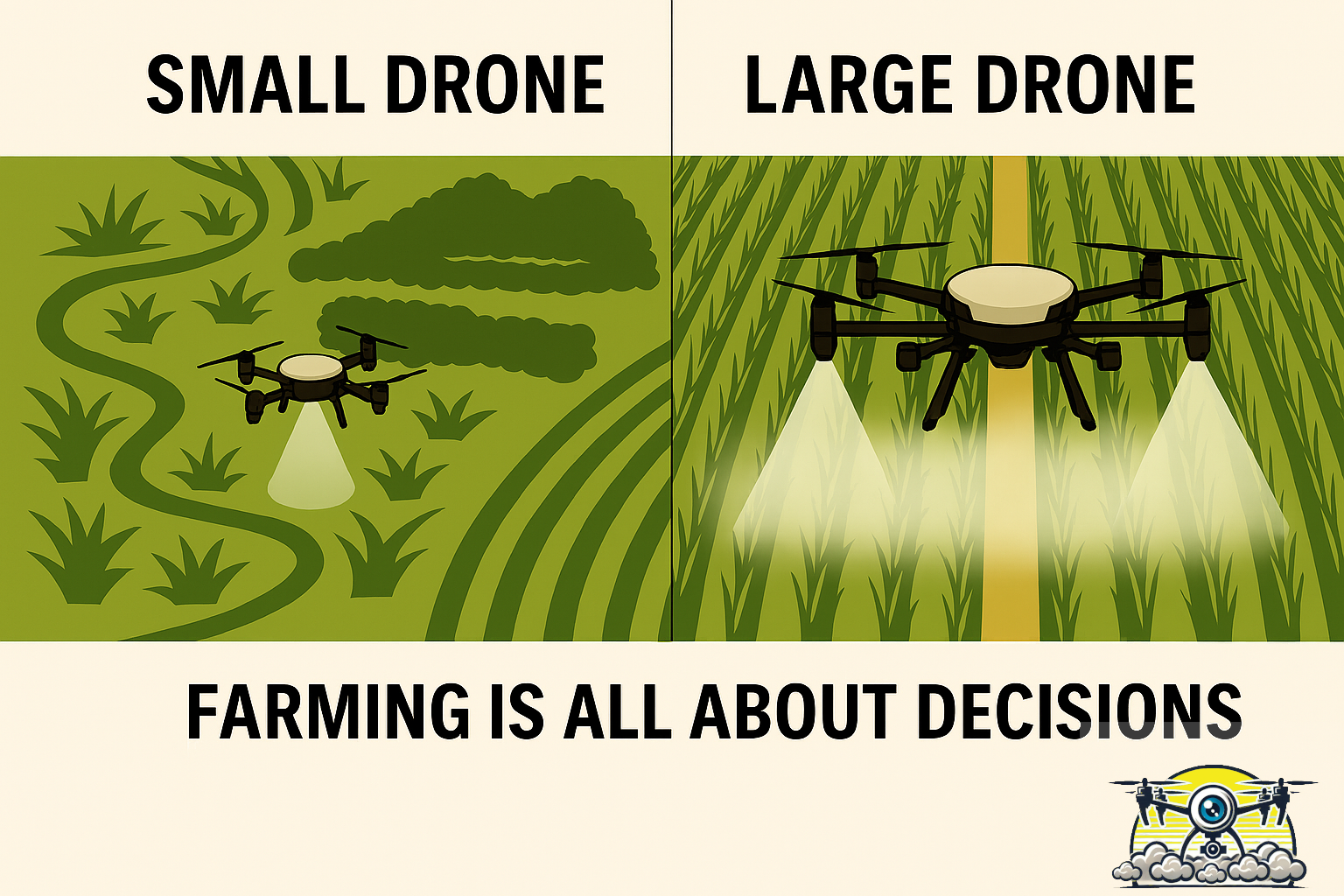
- Small agricultural spray drones excel in small, irregular fields and challenging terrains, providing better maneuverability.
- Large agricultural spray drones work best in expansive, open fields with fewer obstacles, optimizing for speed and volume.
- Understanding the physics behind drone performance helps farmers select the best option for their specific spraying needs.
Agricultural spray drones have moved from novelty to necessity in record time. What started as a niche tool is now a mainstream piece of farm equipment spotted across the Central Plains, proving they can deliver precise coverage, reduce soil compaction, and open up spraying windows that ground rigs simply can’t reach. The technology has matured to the point where drones aren’t just “interesting”—they’re dependable, repeatable, and increasingly central to modern crop protection strategies.
But here’s the real question all farmers should be asking: What is the best spray drone for my farm? The answer isn’t “the biggest tank” or “the newest model.”
Making a purchase decision between small vs large drones comes down to something far more practical: matching the drone to your field size, terrain, and complexity. A drone that crushes acres in a 640‑acre section may be painfully inefficient in a 40‑acre terraced field. Likewise, a nimble small drone that dances around waterways and tree lines may fall behind when you need to cover 900 acres before the wind picks up.
I will attempt in break down the real‑world differences between small vs. large spray drones, how each performs in different field conditions, and why physics plays a bigger role in drone efficiency than most people realize. Which, you know, I love that physics is involved.
Whether you’re buying your first agricultural spray drone or thinking about expanding your fleet of AG drones, this guide will help you choose the right tool for your acres.
Choosing the Right Agricultural Spray Drone Matters
Spray drones come in a wide range of sizes—from 10‑ to 20‑gallon “small” units to 40‑ to 55‑gallon “large” platforms. Each size class has strengths and weaknesses, and choosing the wrong one can cost you acres per hour, battery cycles, and even spray quality. The drone you pick determines how efficiently you can move across your fields, how well you can maintain spray height, and how much time you lose in turns, ferrying to the trailer for refills, and repositioning.
The right drone depends on a combination of factors that are unique to your operation. Field size is the obvious one, but it’s far from the only one. Terrain, obstacles, spray window pressure, and even the distance between your fields all influence which drone will give you the best return on investment. A drone that’s perfect for a Nebraska pivot field might be the wrong choice for a terraced Kansas hillside.
When you match the drone to the farm, you get better coverage, higher efficiency, lower drift risk, and more acres per hour. When you mismatch them you end up fighting the machine—burning batteries, wasting time, and losing efficiency in ways that add up fast.
Small Spray Drones (10–20 Gallons)
Precision Tools for Small Fields and Complex Terrain
Small agricultural spray drones are the unsung heroes of irregular fields, terraces, and short spray runs. They’re fast, nimble, and incredibly efficient in places where larger drones struggle. These drones are built for agility, not brute force, and that makes them ideal for farms with lots of small or oddly shaped fields. If your operation includes 20‑acre patches, narrow headlands, or fields broken up by waterways, a small drone often outperforms a larger one simply because it spends more time spraying and less time maneuvering.
Another advantage of small drones is their ability to adapt quickly to changing conditions. Because they weigh less and have lower inertia, they respond faster to wind gusts, terrain changes, and tight turns. This makes them safer and more predictable in complex environments. They also require less open space for takeoff, landing, and turning, which is a major advantage in fields with trees, terraces, or uneven boundaries.
Where Small Drones Excel
1. Small Fields (5–80 Acres)
Small drones thrive in fields where maneuverability matters more than tank size. They can slip into tight corners, follow irregular boundaries, and maintain efficiency even when the field layout forces frequent turns.
2. Short Spray Runs (Under 600–800 Feet)
Short runs punish large drones. Small drones accelerate faster, turn tighter, and reach full spray speed sooner.
3. Terraces, Hills, and Uneven Ground
Small drones respond faster to terrain changes because they have lower mass and faster altitude correction.
4. Obstacle‑Heavy Fields
Tree lines, poles, and waterways all favor a smaller footprint.
Large Spray Drones (40–55 Gallons)
Acreage Crushers for Big, Open Fields
Large agricultural spray drones are built for volume. They shine in big, clean fields where they can stretch out long spray runs and maximize their swath width. These drones are designed to replace or supplement ground rigs in large‑acre operations, delivering high throughput and consistent coverage across wide, open spaces.
Large drones also excel when spray windows are tight. When you need to finish spraying to beat the weather, a large drone’s combination of tank size, swath width, and reduced refill frequency becomes a major advantage. They’re built for speed and throughput, not agility, and they perform best when the field layout lets them operate without interruption.
Where Large Drones Dominate
1. Large Fields (300–1,000+ Acres)
Long spray runs allow large drones to take full advantage of their wide booms and high flow rates.
2. Flat or Gently Rolling Terrain
Large drones perform best when the ground is predictable.
3. Minimal Obstacles
Large drones need room to work.
4. High‑Volume Spray Windows
When fungicide season hits and every acre counts, large drones deliver.
Comparison Table: Small vs. Large Spray Drones
| Feature | Small Drones (10–20 gal) | Large Drones (40–55 gal) |
|---|---|---|
| Best For | Small/irregular fields | Large, open fields |
| Spray Run Length | Short (<800 ft) | Long (>800 ft) |
| Terrain | Terraces, hills | Flat/gently rolling |
| Obstacles | Excellent around trees/waterways | Struggle in tight areas |
| Turning Radius | Tight, fast | Wide, slower |
| Acceleration | Very fast | Moderate |
| Acres per Hour | High in small fields | High in large fields |
| Refill Frequency | Higher | Lower |
| Spray Height Stability | Excellent in terrain | Best on flat ground |
| Operator Workflow | Frequent field changes | Long continuous runs |
Decision Tree: Which Spray Drone Should You Choose?
Follow this simple path:
1. Are most of your fields under 80 acres?
→ Yes → Choose Small Drone
→ No → Continue
2. Do your fields have terraces, hills, or uneven ground?
→ Yes → Choose Small Drone
→ No → Continue
3. Are your spray runs shorter than 600–800 feet?
→ Yes → Choose Small Drone
→ No → Continue
4. Are your fields mostly large rectangles with long, clean spray lanes?
→ Yes → Choose Large Drone
→ No → Continue
5. Do you need to cover 300+ acres in a tight spray window?
→ Yes → Choose Large Drone
→ No → Continue
6. Do you have many trees, waterways, or narrow headlands?
→ Yes → Choose Small Drone
→ No → Choose Large Drone
Why? Physics, That’s Why.
Farmers don’t need a physics degree to understand why small drones outperform big drones in short‑run or complex fields — but the physics explains exactly what you see in real‑world operations.
1. Small Drones Accelerate Faster
Acceleration is impacted by the available thrust and the mass of the flying unit. Less mass, or more thrust, creates faster acceleration. Small (lighter) drones reach full spead sooner. And they can also stop faster.
2. Small Drones Turn Faster
Large drones have more rotational inertia.
Small drones pivot faster, re‑align faster, and waste less time in the headlands.
3. Small Drones Have a Tighter Turning Radius
Large drones need wide arcs.
Small drones can pivot tight — critical in terraces, waterways, and narrow headlands.
4. Small Drones Maintain Spray Height Better
Terrain‑following is a reaction‑time problem.
Small drones adjust altitude faster and maintain spray height more consistently.
5. Small Drones Spend More Time Spraying
In short‑run fields, small drones minimize:
- Turning
- Accelerating
- Decelerating
- Repositioning
Large drones maximize all of those.
That’s why a small drone can sometimes cover more acres per hour than a large drone in a field full of short, broken‑up spray lanes.