Analysis of Three Years of Tar Spot, and How to Spot It
Key Takeaways
- Tar Spot in northeast Kansas has been confirmed for three consecutive years, spreading earlier and wider each season.
- Counties like Doniphan and Atchison experience higher risk due to favorable conditions for the disease.
- Farmers should monitor fields closely, particularly in river bottoms where humidity and dew promote Tar Spot development.
- Drones can detect early signs of Tar Spot before they are visible to the naked eye, allowing for timely action.
- Applying fungicides from VT to R3 stages can effectively combat Tar Spot and protect yields.
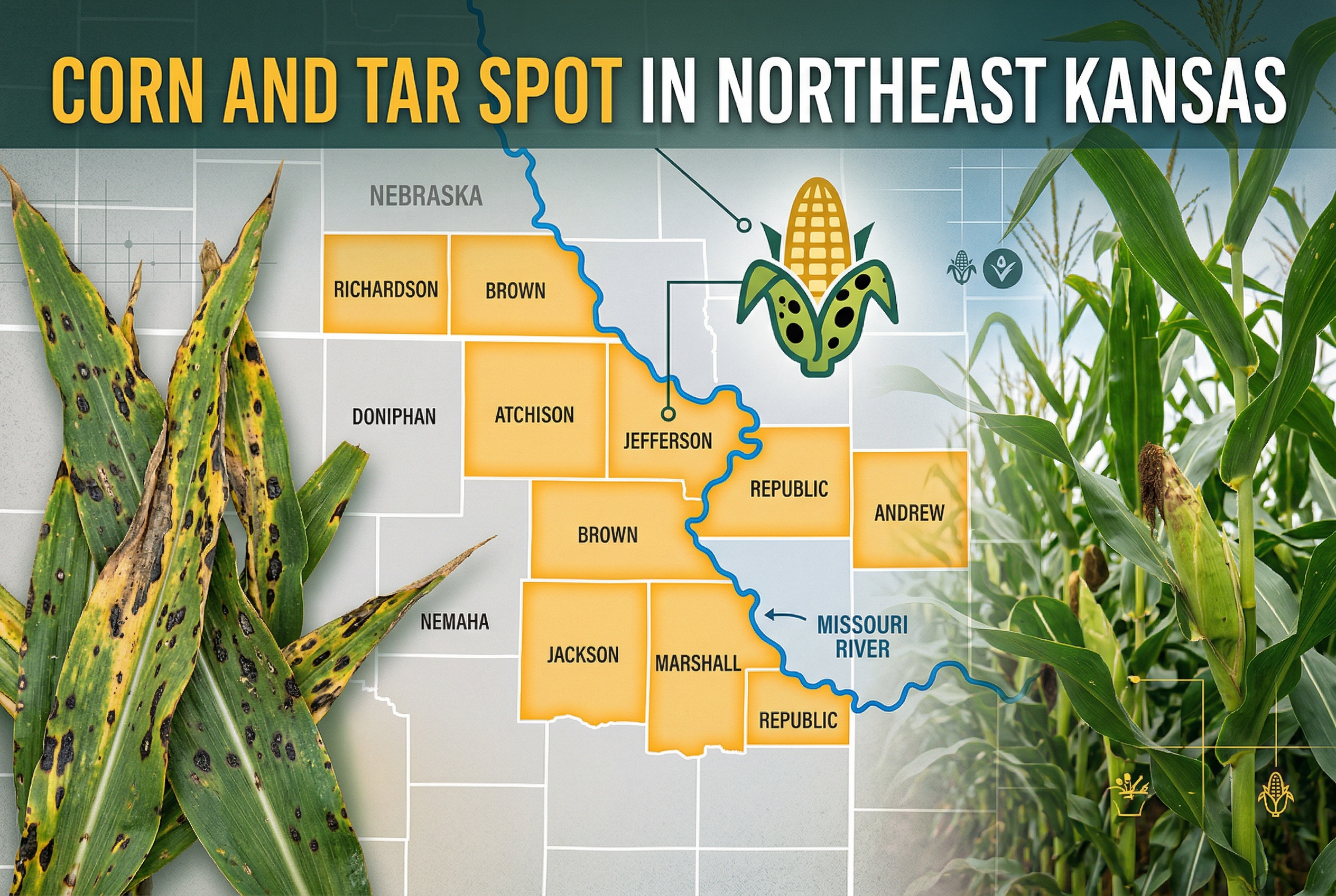
Three years in a row now. That’s how long phyllachora maydis, Tar Spot, has been showing up in corn near me. It seems to arrive a little earlier and spread a little further each year. If you’re farming in Brown, Doniphan, Atchison, Jackson, or Nemaha County, or just across the line in Richardson County, Nebraska, or Andrew and Holt County in Missouri, this disease is already in your neighborhood, spores waiting quietly in your ground and in your crop debris. The question isn’t whether it will show up. The question is whether you’ll catch it in time to do something about tar spot in northeast Kansas.
My family has bottom ground along the Missouri River in Doniphan County, KS. My fields sit in exactly the kind of environment tar spot loves — cooler nights, dew, and evening humidity. I have a personal stake in this topic and spent much of the 2025 growing season worrying about how to identify tar spot with my scouting drone. I was lucky because none of the fields I was watching were impacted.
I wanted to know more about how we should deal with tar spot in northeast Kansas and so fired up the computer to find out. Here’s what I found and maybe what it means for our future growing seasons.
Three Years of Confirmed Cases in Northeast Kansas
This isn’t a disease that shows up once and goes away. K-State Research and Extension has documented confirmed tar spot cases in northeast Kansas in 2023, 2024, and 2025. Here’s the county-by-county picture:
2023 NE Kansas Confirmed Cases:
- Doniphan County — June 26
- Atchison County — June 30
- Jefferson County — June 30
- Brown County — July 5
- Nemaha County — July 28
- Jackson County — August 8
- Marshall County — August 22
K-State reported that 2023 severity was much higher than 2022, with severe yield impact in several northeast Kansas fields. [1]
2024 NE Kansas Confirmed Cases:
- Doniphan County — May 27
- Atchison County — June 4
- Jefferson County — June 14
- Nemaha County — June 18
- Brown County — July 8
K-State noted that the early onset in 2024 raised serious concern for yield loss. Generally, earlier detection corresponds to higher yield loss. [1]
2025 NE Kansas Confirmed Cases:
- Doniphan County — June 11
- Brown County — June 17
- Jefferson County — June 23
- Atchison County — July 2
- Republic County — July 7
- Marshall County — July 9
The trend seems clear: tar spot is being identified earlier in a wider area each year. Doniphan County has been first in Kansas all three years running. Unfortunately, farms far away from the bottoms are being impacted!
It Doesn’t Stop at the State Line
If you’re watching the Kansas map and thinking you’re safe because your county hasn’t shown up yet, look at what’s happening just across the river.
Nebraska:
Richardson County sits directly north of Brown and Doniphan counties. UNL Extension has confirmed tar spot in Richardson County, and Nebraska plant pathologist Tamra Jackson-Ziems noted in early 2025 that the hot zone for tar spot in Nebraska is in the eastern most state counties. That includes Richardson County. She also notes that tar spot has been confirmed as far west as Brown County, Nebraska. [2]
Missouri:
Andrew County, Missouri, bordering Doniphan County, was confirmed with tar spot in 2024 per MU Extension and Corn ipmPIPE. Holt County, also on our doorstep in northwest Missouri, was one of the first confirmed cases in Missouri in June 2023 — the earliest the disease had ever appeared in that state at that time. [3]
MU Extension plant pathologist Mandy Bish confirmed tar spot in 19 Missouri counties in 2024, and noted that the disease is expected to continue spreading in 2025. She also confirmed that tar spot has been showing up in Missouri in June — far earlier than the August and September appearances seen in previous years. [4]
The picture is forming for me: northeast Kansas is surrounded on multiple sides by confirmed tar spot pressure. Spores move by wind and rain. There is no fence between your field and the next that can stop the spores.
River Bottoms Are Ground Zero
Tar spot thrives in specific conditions. Research has shown it favors mean daily temperatures in the mid-60s to low 70s, relative humidity above 75%, and extended periods of leaf wetness — at least seven hours is enough to get it going. [5]
If you farm the Missouri River bottoms in Doniphan County, or in any of the bordering counties, you know exactly how the river can impact farming. For good and bad. The bottom ground holds moisture. Dew can be heavy and can remain on the leaves well into the morning. Nights are cooler than the upland ground because cold air sinks. Fog is common.
There’s a reason Doniphan County has led Kansas in early tar spot detection all three years running. I guess the geography works against us. That same rich, productive bottom ground that grows heavy corn is also the most favorable environment in the region for this disease.
UNL’s Jackson-Ziems also noted that irrigated fields were particularly hard hit in Nebraska, overhead irrigation adds the leaf wetness that tar spot needs to develop and spread. If you’re running pivots on bottom ground, you may be running the highest-risk acres in your operation. [2]
What It Can Cost Us
The Crop Protection Network has documented yield losses ranging from zero to more than 50 bushels per acre, depending on hybrid susceptibility, timing of infection, and weather conditions. In experimental plots, losses of 20 to 40 bushels per acre were recorded when 50% of the ear leaf was covered in tar spot lesions at dent stage. [5]
Nationally, the Crop Protection Network estimated that tar spot claimed roughly 293 million bushels across the U.S. in 2024 alone. [6] That is real-world impact. It is what happens when the spores get into fields at the wrong time with the wrong hybrid and no fungicide in the window.
K-State was direct about it in their 2024 alert: early onset of tar spot has generally corresponded with higher yield loss. When Doniphan County showed a confirmed case on May 27, 2024, one of the earliest confirmed cases in Kansas history, that was a warning flag for the whole northeast corner of the state. [1]
What a Drone Sees That You Can’t
The challenge with tar spot is we cannot see it until it has already developed a hold on the field. It may be lurking too deep in the canopy for easy scouting. The disease starts in the lower and middle canopy, where it is tough to see when corn is tall and thick. Worse, it can move fast with ideal conditions.
A multispectral drone camera picks up plant stress before it’s visible to the eye. Infected plants start to change the way they reflect light, specifically in the near-infrared spectrum, before the damage is obvious from the ground. An NDVI map produced after a flight will show those stressed zones as different colors compared to healthy areas of the field.
This map tells us exactly where we need to foot-scout to personally check on conditions. It can save us from walking the full 160-acre field in summer heat and humidity! Simply walk straight to those zones and confirm what you’re seeing.
MU Extension has specifically noted that tar spot tends to stay in the lower canopy in its early stages, exactly where it’s hardest to spot on foot and where drone-assisted scouting pays off most. [4]
When to Scout and When to Act
Research all seems to point to the same fungicide window: VT through R3. Fungicide applications made just after first detection and at or after VT have shown the most consistent results in research. Fungicide applications after R5 show no yield benefit. [1, 3, 4]
Given that Doniphan County has seen confirmed tar spot as early as late May, and that the disease tends to build in the lower canopy before it becomes obvious, a scouting flight in late June through early July on your highest-risk ground is a sound practice. That’s your bottom ground, your irrigated acres, your corn-on-corn fields, and any field that took a hit in 2023 or 2024.
Using Drones can reduce your tax!
Section 41 of the TAX code allows some of the cost R&D activities to turn into a TAX Credit. Testing new techniques is encouraged by the Government, and use of drones or hiring a drone service is an allowable activity.
Parting Thoughts
Three years of data, confirmed in our own counties, with the disease arriving earlier every season. That’s not a trend you can wait out.
My farm is in the bottoms. I understand the risk personally. The combination of our geography, our humidity, our heavy dew, and the fact that tar spot overwinters in corn residue, meaning last year’s infected fields are this year’s starting point, makes northeast Kansas some of the highest-risk ground in the state.
Taking care of your fields, ensuring tar spot doesn’t take hold, helps your neighbor take care of their fields. We all share responsibility for these kinds of pressure. Getting eyes in the air early, before tar spot gets established in the canopy, is the difference between catching it in time and watching yield decrease.
Let’s work together! Connect with me if you want to discuss scouting your fields.
Further Reading
[1] Onofre, R. “Tar Spot is Active in Five Counties in Northeast Kansas.” K-State Research and Extension eUpdate. 2024. https://eupdate.agronomy.ksu.edu/article/tar-spot-is-active-in-five-counties-in-northeast-kansas-599-4
[2] Jackson-Ziems, T. “Add Southern Rust to Your Watch List.” Nebraska Farmer / UNL Extension. March 2025. https://digitaledition.qwinc.com/publication/?i=843779&article_id=4955829
[3] Bish, M. “Tar Spot of Corn Confirmed in June in Missouri — the Earliest Ever.” MU Extension / ipm.missouri.edu. June 2023. https://ipm.missouri.edu/croppest/2023/6/tarSpot-MB/
[4] Bish, M. “Tar Spot Growing in Missouri Corn Crops.” MU Extension. July 2024. https://extension.missouri.edu/news/tar-spot-growing-in-missouri-corn-crops
[5] Crop Protection Network. “Tar Spot of Corn Web Book.” https://cropprotectionnetwork.org/web-books/tar-spot-of-corn
[6] AgWeb / Crop Protection Network. “Tar Spot of Corn: A Growing Threat to U.S. Yields.” May 2025. https://www.agweb.com/news/crops/tar-spot-corn-threat